


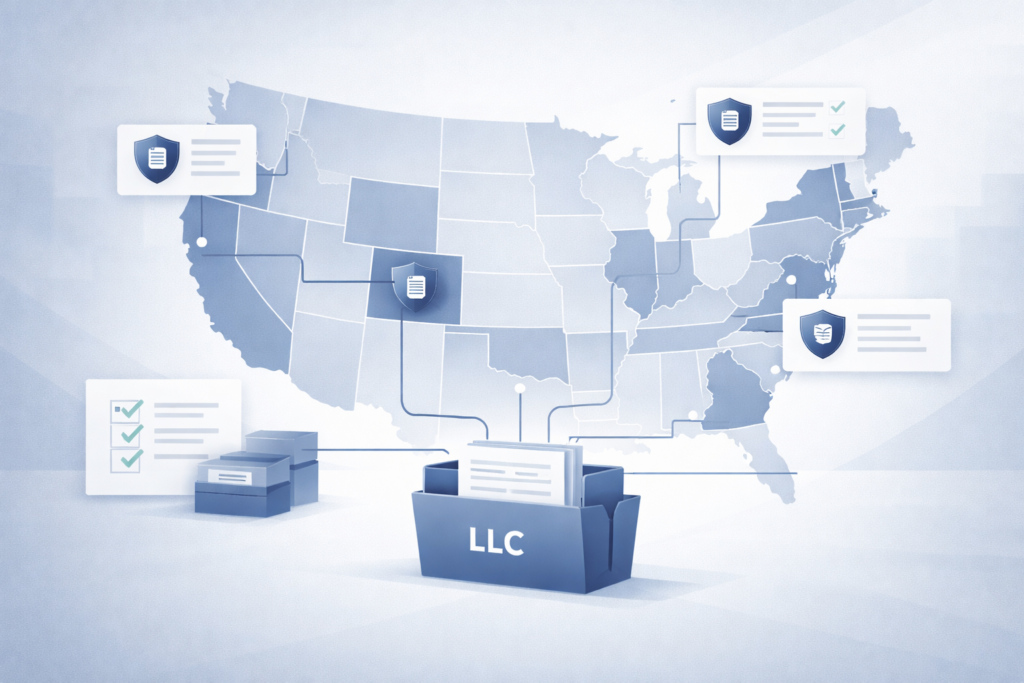
Multi-state LLC compliance checklist is essential for any business operating beyond its home state. Whether you’re a U.S. entrepreneur expanding operations or a foreign founder running a U.S. LLC remotely, understanding compliance across states can protect you from penalties, lawsuits, and forced dissolution.
Operating in multiple states brings growth—but it also brings legal responsibilities that many businesses overlook until it’s too late.
- Introduction
- What Is a Multi-State LLC Compliance Checklist?
- Why Multi-State LLC Compliance Matters
- Understanding “Doing Business” in Multiple States
- Step-by-Step Multi-State LLC Compliance Checklist
- Registered Agent Requirements Across States
- State Taxes and Multi-State Nexus
- Accounting and Record-Keeping Requirements
- Impact on Business Reporting
- Detailed Examples & Mini Case Studies
- Industry-Specific Multi-State Practices
- Common Mistakes & Solutions
- Best Practices for Multi-State LLC Compliance
- Tools, Software & Resources
- FAQs – Multi-State LLC Compliance Checklist
- 1. Do I need to register my LLC in every state?
- 2. What happens if I don’t foreign qualify?
- 3. Can one registered agent cover all states?
- 4. Does online business require multi-state registration?
- 5. Are foreign founders subject to the same rules?
- 6. Is BOI filing mandatory?
- 7. How often should compliance be reviewed?
- Conclusion
- Call to Action
Introduction
Expanding your LLC into multiple U.S. states is exciting. It means more customers, higher revenue, and stronger brand presence. But growth without compliance is risky.
Many business owners assume that forming an LLC in one state allows them to operate everywhere. Unfortunately, that’s not how U.S. law works.
Each state has its own rules. When your LLC crosses state lines—physically or digitally—you may trigger compliance obligations that include foreign qualification, state taxes, annual reports, registered agents, and ongoing filings.
This multi-state LLC compliance checklist will walk you through everything you must do—step by step—so your business remains legally protected and operationally smooth.
What Is a Multi-State LLC Compliance Checklist?
A multi-state LLC compliance checklist is a structured list of legal, tax, and administrative requirements an LLC must follow when operating in more than one U.S. state.
It ensures that your business:
- Is legally authorized to operate in each state
- Meets state tax obligations
- Maintains good standing
- Avoids fines, penalties, or forced shutdowns
This checklist applies to:
- U.S.-based companies expanding nationwide
- Foreign founders running U.S. LLCs remotely
- E-commerce businesses selling across states
- SaaS companies with remote employees
- Consultants and agencies serving clients nationwide
Why Multi-State LLC Compliance Matters
Ignoring compliance doesn’t just create paperwork issues—it can directly harm your business.
Legal Consequences
- State fines and penalties
- Inability to file lawsuits
- Loss of limited liability protection
- Forced dissolution or suspension
Financial Impact
- Back taxes with interest
- Late filing penalties
- Unexpected compliance costs
Reputation Risk
- Banks may freeze accounts
- Payment processors may flag accounts
- Investors may walk away
Following a proper multi-state LLC compliance checklist protects your company at every level.
Understanding “Doing Business” in Multiple States
Before registering in another state, you must understand what legally counts as “doing business.”
Most states define doing business as:
- Having a physical office or warehouse
- Employing workers in the state
- Holding inventory
- Regular in-person sales activities
- Significant revenue sourced from the state
Activities that usually DO NOT trigger registration:
- Occasional sales
- Online-only presence (sometimes)
- Passive income
⚠️ Each state interprets this differently—this is where many businesses make mistakes.
Step-by-Step Multi-State LLC Compliance Checklist
Step 1: Identify States Where You Operate
Create a list of all states where your LLC:
- Has customers
- Has employees or contractors
- Stores inventory
- Advertises heavily
- Has recurring revenue
This becomes the foundation of your compliance strategy.
Step 2: Determine Nexus
“Nexus” means sufficient connection with a state.
Types of nexus:
- Physical nexus – office, employee, warehouse
- Economic nexus – revenue or transaction thresholds
- Affiliate nexus – partners or agents
Most states now apply economic nexus rules, especially after the Wayfair Supreme Court ruling.
Step 3: Foreign Qualification
If your LLC is formed in one state but operates in another, you must file for foreign qualification.
Foreign qualification includes:
- Certificate of Authority
- State filing fees
- Good standing certificate from home state
Without it, your LLC is technically operating illegally in that state.
(Foreign LLC Registration Guide)
Step 4: Appoint a Registered Agent in Each State
Every state requires a registered agent with a physical address.
You must:
- Appoint one registered agent per state
- Maintain active service continuously
- Update changes promptly
Missing registered agent notices is one of the biggest compliance failures.
(Registered Agent Services for Multi-State LLCs)
Step 5: Register for State Taxes
Depending on activity, you may need:
- State income tax registration
- Sales tax permit
- Employer withholding tax
- Franchise or gross receipts tax
Each state has its own thresholds and deadlines.
✅ Step 6: File Annual Reports
Almost every state requires annual or biennial reports.
These reports typically include:
- Business address
- Members/managers
- Registered agent confirmation
Missing reports can lead to administrative dissolution.
✅ Step 7: Maintain BOI Reporting (Federal)
Under FinCEN rules, most U.S. LLCs must file Beneficial Ownership Information (BOI) reports.
This applies to:
- Domestic LLCs
- Foreign LLCs registered in U.S. states
Failure may result in federal penalties.
(BOI Filing Requirements for LLCs)
Registered Agent Requirements Across States
A registered agent must:
- Be available during business hours
- Receive legal notices
- Receive government correspondence
Multi-state businesses usually choose professional registered agent providers to centralize compliance.
State Taxes and Multi-State Nexus
Types of taxes you may face:
- Income tax
- Franchise tax
- Sales tax
- Gross receipts tax
Example:
If your LLC is formed in Wyoming but sells products to California customers with high revenue volume, California may require registration and tax payments.
This is why a proper multi-state LLC compliance checklist is critical.
Accounting and Record-Keeping Requirements
Multi-state LLCs must maintain:
- Separate state revenue tracking
- Expense allocation
- Sales tax records
- Payroll documentation
Accurate accounting ensures correct filings and protects against audits.
(LLC Accounting Setup Guide)
Impact on Business Reporting
Compliance affects:
- Financial statements
- Tax reporting accuracy
- Investor due diligence
- Bank relationship stability
Non-compliant LLCs appear high-risk to banks and partners.
Detailed Examples & Mini Case Studies
Case Study 1: E-commerce Brand
A Texas LLC sells nationwide via Shopify.
Trigger events:
- Inventory stored in Amazon FBA warehouses
- Sales tax nexus in 12 states
Solution:
- Foreign qualification
- Multi-state sales tax registration
- Automated tax software
Result: Fully compliant and scalable business.
Case Study 2: SaaS Startup
Delaware LLC with remote employees in 4 states.
Trigger events:
- Payroll nexus
- State employment taxes
Solution:
- Foreign registration
- Payroll tax setup
- Annual reporting calendar
Case Study 3: Non-US Founder
Indian founder operating a Wyoming LLC.
Trigger events:
- Registered in multiple states for clients
- BOI reporting
- EIN and tax filings
Proper compliance avoided IRS and state penalties.
Industry-Specific Multi-State Practices
E-commerce
- Sales tax automation
- Inventory tracking
SaaS
- Remote employee compliance
- Data nexus review
Consulting & Agencies
- Client-location-based nexus
- Service tax rules
Real Estate
- Property-based registration
- Local licensing
Common Mistakes & Solutions
❌ Assuming one LLC works nationwide
✅ Register properly in each state
❌ Ignoring sales tax nexus
✅ Monitor thresholds regularly
❌ Missing annual reports
✅ Use compliance calendars
❌ No registered agent updates
✅ Centralize agent management
Best Practices for Multi-State LLC Compliance
- Maintain a compliance calendar
- Use professional registered agent services
- Review nexus annually
- Keep clean accounting
- File early, not late
Tools, Software & Resources
- Registered agent management platforms
- Sales tax automation tools
- Accounting software (QuickBooks, Xero)
- Compliance tracking dashboards
FAQs – Multi-State LLC Compliance Checklist
1. Do I need to register my LLC in every state?
Only in states where you are legally “doing business.”
2. What happens if I don’t foreign qualify?
You may face fines, penalties, and loss of legal rights.
3. Can one registered agent cover all states?
No. Each state requires its own registered agent.
4. Does online business require multi-state registration?
Sometimes—economic nexus rules may apply.
5. Are foreign founders subject to the same rules?
Yes. Non-US owners must follow the same compliance laws.
6. Is BOI filing mandatory?
Yes, for most LLCs under FinCEN regulations.
7. How often should compliance be reviewed?
At least once per year or whenever you expand operations.
Conclusion
Managing compliance across multiple states doesn’t have to be overwhelming—but it must be done correctly.
A proper multi-state LLC compliance checklist ensures your business remains protected, scalable, and legally secure as it grows across the United States.
Ignoring compliance can silently destroy otherwise successful businesses. Following it builds long-term stability.
Call to Action
If you’re planning to expand your LLC into multiple states—or already operating across state lines—don’t leave compliance to guesswork.
👉 Explore our multi-state LLC registration and compliance services
👉 Get help with foreign qualification, registered agents, BOI filing, and ongoing compliance management

