


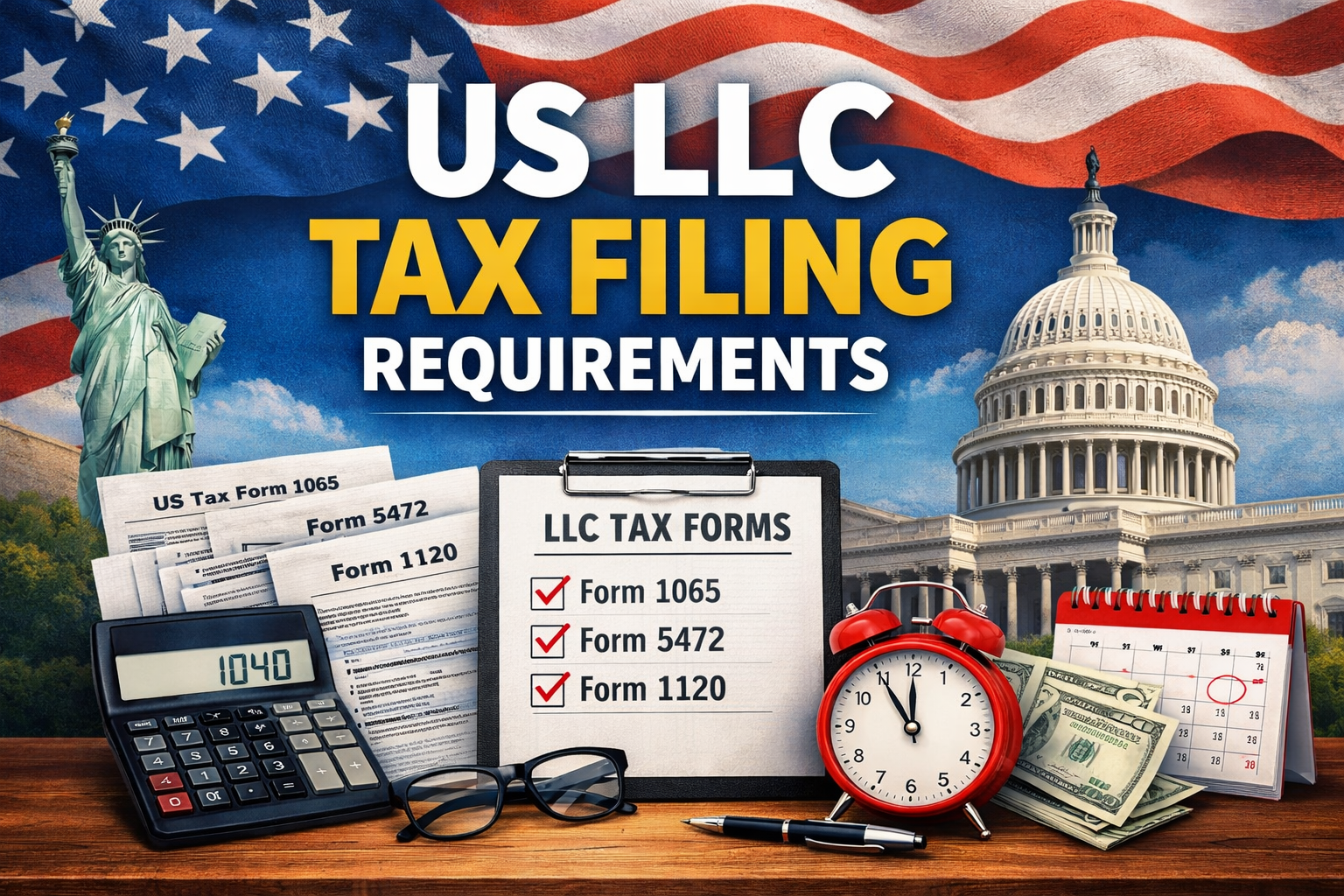

- Do All US LLCs Need to File Taxes?
- US LLC Tax Filing Requirements by LLC Type
- Can an LLC Choose Corporate Taxation?
- Important Annual US LLC Filing Deadlines
- State-Level Tax Filing Requirements
- Role of the Internal Revenue Service (IRS)
- Common Mistakes LLC Owners Make
- FAQs on US LLC Tax Filing Requirements
- Conclusion
Running a US LLC comes with many benefits, but tax compliance is one responsibility you cannot ignore. Whether your LLC is owned by a US resident or a foreign national, understanding US LLC tax filing requirements is critical to avoid penalties, fines, or even dissolution.
In this guide, we’ll break everything down in plain English—no legal jargon, no confusion—so you know exactly what your LLC must file, when to file it, and which forms apply to your situation.
Do All US LLCs Need to File Taxes?
Yes. Every US LLC has tax filing obligations, even if:
- The LLC made no income
- The LLC had no business activity
- The owner lives outside the United States
The exact filing requirements depend on:
- Number of owners
- Owner’s residency (US or non-US)
- Whether the LLC earned US-sourced income
- Tax classification of the LLC
US LLC Tax Filing Requirements by LLC Type
Single-Member LLC (SMLLC)
A single-member LLC is treated as a disregarded entity by default.
If the owner is a US resident:
- File Schedule C with the personal tax return (Form 1040)
- Pay income tax and self-employment tax
If the owner is a non-US resident:
- File Form 5472
- Attach a pro-forma Form 1120
- Filing is required even if there is zero income
Missing Form 5472 can trigger penalties starting at $25,000.
Multi-Member LLC
A multi-member LLC is treated as a partnership by default.
Key filing requirements:
- File Form 1065 (Partnership Return)
- Issue Schedule K-1 to each member
- Members report income on their personal or corporate returns
This applies whether members are US residents or foreign nationals.
Can an LLC Choose Corporate Taxation?
Yes. An LLC can elect to be taxed as a C-Corporation or S-Corporation.
LLC Taxed as C-Corporation
- File Form 1120
- Pay corporate income tax
- Separate taxation from owners
LLC Taxed as S-Corporation
- File Form 1120-S
- Owners receive Schedule K-1
- Only available to eligible US residents and citizens
Important Annual US LLC Filing Deadlines
| Form | Deadline |
|---|---|
| Form 5472 | April 15 |
| Form 1065 | March 15 |
| Form 1120 / 1120-S | April 15 |
| State Annual Report | Varies by state |
Late filing can result in penalties, interest, and compliance issues.
State-Level Tax Filing Requirements
In addition to federal taxes, most states require:
- Annual reports or franchise tax filings
- Registered agent maintenance
- State income tax returns (if income is sourced in that state)
States like Delaware, Wyoming, and Texas have unique compliance rules that must be followed every year.
Role of the Internal Revenue Service (IRS)
All federal LLC tax filings are submitted to the IRS. The IRS enforces:
- Reporting accuracy
- Filing deadlines
- Penalties for non-compliance
Foreign-owned LLCs are especially scrutinized, making accurate filing essential.
Common Mistakes LLC Owners Make
- Assuming “no income” means “no filing”
- Missing Form 5472 for foreign-owned LLCs
- Filing the wrong tax classification
- Ignoring state-level requirements
- Missing deadlines and extensions
Avoiding these mistakes can save thousands of dollars in penalties.
FAQs on US LLC Tax Filing Requirements
Do US LLCs need to file taxes if there is no income?
Yes. Even inactive or zero-income LLCs usually have filing obligations.
Do foreign-owned LLCs pay US taxes?
Foreign owners must file required forms and may pay tax on US-sourced income.
What happens if I miss the filing deadline?
Late filings can result in penalties, interest, and compliance notices.
Can I file US LLC taxes myself?
Some filings are simple, but foreign-owned and multi-member LLCs often require professional help.
Is Form 5472 mandatory every year?
Yes, if the LLC is foreign-owned, Form 5472 must be filed annually.
Conclusion
Understanding US LLC tax filing requirements is not optional—it’s essential for keeping your business compliant and protected. The exact forms and deadlines depend on your LLC’s structure and ownership, but every LLC must file something each year.
If you’re unsure about your obligations or want peace of mind, working with an experienced US LLC tax professional can help you stay compliant, avoid penalties, and focus on growing your business instead of worrying about paperwork.
Permalink